Monday, October 1, 2012

Yachats 804 Trail - Coastal Connections


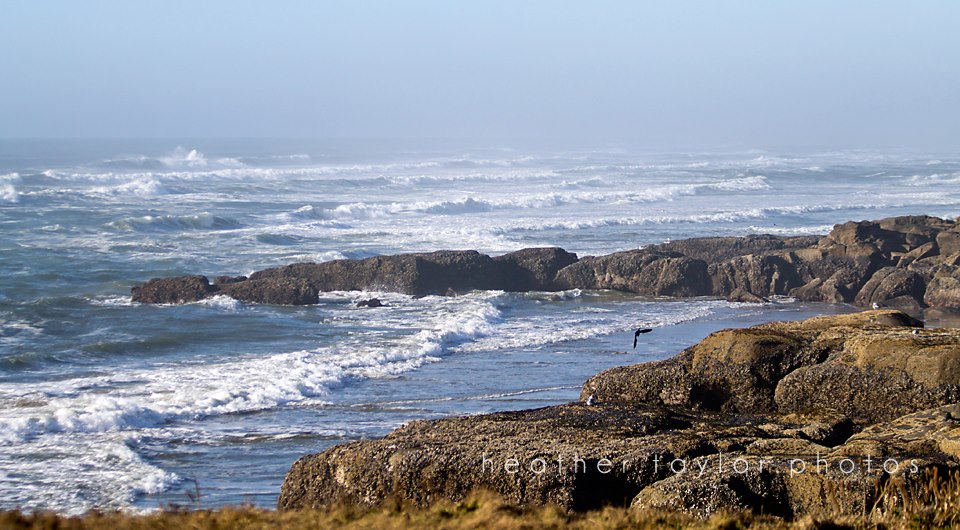
Walking the historic Yachats 804 Trail connects hikers to local coastal history. The trail probably first served as a footpath for tribal people, later becoming part of County Road 804, which included the 7-mile stretch of beach between Yachats and Waldport at low tide. County Road 804 served as the settler's route of travel between the farmland of the upper Yachats River valley and Waldport's Alsea Bay until the 1930s and the completion of Highway 101. The highway replaced the oceanside portion of County Road 804, and it reverted to its ancient use as a footpath. 

During the 1970s, local citizens began a campaign to preserve the 804 as a public trail. Years of legal battles ended with a ruling by the Oregon Supreme Court to keep the public right-of-way and in the mid-eighties, the ¾ mile section from Smelt Sands State Park north to the beach became part of Oregon State Parks.

Successful mediation with local home owners in the late 1990s allowed for the completion of the 804 Trail South. The 804 Trail South is about a mile in length, stretching from the south edge of Smelt Sands Recreation Site, across the lawn behind the Adobe Resort, and through oceanside neighborhoods to the north side of the Yachats River, Yachats State Recreation Area, and downtown Yachats. 

The city’s commitment to trails for safe pedestrian use has resulted in a network of trails through Yachats. The trails connect to the Amanda Trail south of town, and up to Cape Perpetua and beyond. Volunteers and city workers, in partnership with State Parks and the US Forest Service, maintain the trails, build new trails, and develop maps and signage. 
(This article is a modification of the Yachats Chamber of Commerce history of the 804. More information is available online.)

Photo Credit: Heather Taylor

Wednesday, August 8, 2012

Cars and Bikes—Let’s All Be Safe This Summer!


It’s summer, and there are plenty of two-wheelers on the coast roads--taking the turns on 101, pumping hard up and over the coast range, or taking a leisurely ride through pretty rural valleys. Oregon welcomes cyclists and encourages cycling adventures as an integral part of the TravelOregon story, so now is a good time for everyone—motorists and cyclists—to keep a few safety thoughts in mind.

For example, sometimes it’s a pretty tight fit going around the curves south of Yachats.  While the bike lane can be up to three feet wide, there are places where it narrows next to a guard rail or just plain disappears under overgrown vegetation. Cyclists are often in the traffic lane and even where they are safely on their side of the fog line, cautious motorists tend to pull over to give the bikes plenty of room. Oregon law allows drivers to pass bicycles on the left by moving across the center line as long as the “center is unobstructed for a sufficient distance to permit the driver to pass the person operating the bicycle safely and avoid interference with oncoming traffic.” 


Most cyclists take advantage of the north winds and ride south along 101. Coming up suddenly on a line of cyclists, drivers tend to move out into the other lane—which means everyone needs to stay very alert, including the people driving north. 

On most rural roads, there is no bike lane. This means that cyclists and motorists are sharing the road. Take that phrase to heart. Sometimes there are whole families riding their bikes up the Yachats River Road. It’s a beautiful ride past grazing cows, solid red barns, alpacas and llamas, and views of the wooded hills. In fact, with the Third Annual Yachats River Valley Farm Tour coming up on August 18 (see GoYachats.com/events for details), Biking from farm to farm would be a great way to see the valley up close.


Sometimes there’s no alternative to just simply slowing down. Going around curves, drivers can come upon bikes suddenly. With the play of light and shadow on the road, bikes and their riders are often difficult to see. Assume that you won’t be able to pass safely and drive cautiously. It really won’t hurt to slow down. After all, that’s the whole point of being on vacation, isn’t it? And if you’re a local trying to take care of all the ordinary chores, slow down anyway—just remind yourself that you are lucky enough to live in a place that people come to on their vacation!

Wednesday, July 4, 2012


Love LaDeDa (and Yachats!)? Say thanks to Janet Moore Burley. Eighteen years ago she was head of the Yachats Chamber. Inspired by Pasadena's DoDah parade, she applied to the city council for a permit and wrote the rules: no motorized vehicles and no green socks. Or maybe it was purple socks. Whatever.

The idea was simple—get people to town before the fireworks. The first parade was so short, it went around twice. But it caught on, and soon crowds lined the parade route, floating red, white, and blue balloons, decked out in as much R,W, & B as they could fine. That’s the spectators we’re talking about—as good a show as the people in the parade.

The exception to the motorized vehicle prohibition is the municipal manure spreader, which carries the mayor and members of city council. Now what might that message be????
Paraders come in singles and groups, families and associations. The city’s hyperactive trails committee and adjunct weed-pullers (YIPS) deck themselves out in ivy and other invasives. There’s always a science team with strange images of deep sea critters. Look for people on bikes and people on skate boards, and dogs dogs dogs. The ever-popular Umbrella Drill Team, which has been opening and closing umbrellas in something like synchronicity almost as long as the parade has existed, will march by in semi-unison.

I’ve been in Yachats almost as long as the parade and I know it is not an event to miss. Get out there and laugh, gawk, gasp in amazement, clap and let the crazies know how much we all appreciate them. Then wander around Yachats and ENJOY!! I know I will.

Monday, September 12, 2011

The Impact of Climate Change on the Oregon Coast

The damage done recently by hurricanes along the east coast provides dramatic evidence of the impacts of climate change on vulnerable coastal communities. So far, the west coast has appeared to be exempt from such natural disasters, but this reprieve is unlikely to last forever. Higher ocean levels, erosion of coastlines, and more violent storms will cause damage to land and buildings along the coast. How will we prepare for what the future is sure to bring? One way is to be informed and understand the forces at work.

For the past forty years, Oregon Shores/Coast Watch has worked to keep our beaches accessible to the public, to keep them clean, and to increase our understanding of the coastal environment. Not surprisingly, Oregon Shores has taken on the challenge of climate change as well.

This is the topic of the Oregon Shores 28th annual conference, to be held this year on Saturday, September 17, in Newport. The lineup of speakers represents a depth of knowledge which we all need to understand and prepare for what climate change is likely to do to our coastal communities.

Al Solomon, a recently retired global change ecologist who was head of the U.S. Forest Service’s climate research team in Washington DC, will speak on “Climate Change and Its Impacts on Coastal Oregon.”    

Steve Adams, managing director of the Climate Leadership Initiative, associated with Willamette University, will discuss “Preparing for Climate Change on the Oregon Coast: Insights for Local Climate Adaptation From Initiatives Around the Country.”

Also speaking will be Oregon State University historian William Robbins. His talk, “Industrializing Oregon’s Coastal Watersheds: The Consequences of Hubris” will explore ways in which human activity has changed the coastal landscape over the past two centuries.

Finally, geologist George Priest of the Oregon Department of Geology and Mineral Industries will address the question “The March 2011 Tsunami: Could It Happen Here?”

There are other activities planned, including a luncheon, a dinner cruise of Yaquina Bay, and a bonfire in Nye Beach. For more information about the conference or to register offline, contact Pat Wolter, 503 647-2012, or email: pcwolter@comcast.net. For online registration, visit www.oregonshores.org.

Monday, May 30, 2011

Remembering History, Healing the Past

From left to right, Ron Brean, Mayor of Yachats, Robert Keeler, Chair of the Oregon Historical Marker Committee, and Warren Brainard, Chief CTCLUS
On Friday, May 27, the new historical marker was dedicated at Yachats State Park. The sign, sponsored by the City of Yachats and the Oregon Travel Information Council, is the newest member of the regional marker series, and the first on the coast.

Our new sign tells the story of the land and the people who have lived here. The land was formed fifty thousand years ago, as tectonic plates collided with the continental land mass. People arrived at least five thousand years ago, migrating over the Arctic land bridge from Asia and slowly making their way down the coast. About three hundred years ago, new people arrived from Europe and other parts of America. Every movement, both geological and cultural, changed the landscape, but once the Euro-Americans arrived, change began happening at an accelerated pace.

The marker celebrates the industry of the early pioneers whose can-do energy created an economy based on timber and fishing. Small farms were carved out of the wilderness and gradually transportation shifted as highways were constructed along the rugged coastline. But the marker also pays homage to the history of the Native peoples who were displaced and in many cases destroyed by the activities of the newcomers. The Alsi people, already decimated by disease, and the Coos and Lower Umpqua who were forcibly marched to Yachats, were confined to the Alsea Sub-agency, a part of the larger Coast Reservation (1859-1875), Many perished due to the neglect, abuse, and broken promises of the federal government. The surviving Coos and Lower Umpqua, many of whom are now part of the Confederated Tribes of the Coos, Lower Umpqua, and Siuslaw Indians (CTCLUSI), and what remained of the Alsi (now part of the Confederated Tribes of Siletz) had such feelings of horror about Yachats that they avoided the area entirely.

However, a healing has taken place, thanks to many members of the Yachats community and the willingness of the Tribes to open their hearts to the offer of reconciliation. The dedication ceremony was attended by Chief Warren Brainard of the CTCLUSI, who remembered those who died and also looked forward to the new connections being forged between the two communities. Tribal Elder Doc Slyter saluted the Ancestors with his flute music. And Yachats Mayor Ron Brean spoke movingly about the pace of change and the need for healing and care so that we become mindful of the results of our actions and avoid damage to our beautiful environment and all the people who live here and call it home.

GoYachats salutes all the People of the Oregon Coast!

Monday, May 23, 2011

Remembering the ladies....

When you head over to the Yachats Ladies Club on Saturday (visit GoYachats.com for hours and location) for the pie social, take a minute to appreciate the ladies and what they have accomplished.

The Yachats Ladies Club started in 1927 with fourteen members and a purpose: to promote the welfare of the community. They met in members’ homes, charged 10 cents at each business meeting for dues, and raised additional funds by making and selling quilts and aprons, holding banquets and dances, and organizing a Christmas bazaar.

When the state of Oregon announced they were going to demolish the Yachats Dance Hall to make way for a park at the point, the members of the club decided to buy the building for a clubhouse. That was in March, 1928; by the end of the year, the Ladies Club had $100.32 in their treasury.

The amount of money they needed was daunting. The state agreed to sell the dance hall for $100, but they needed a place to put it. Sir Robert Perks, an Englishman who owned much of the available land in Yachats at that time, agreed to donate the lot on Third Street, and the stumps were removed with 20 pounds of blasting powder. The dance hall was moved at a cost of $500, and they bought a piano for $100. Money was borrowed and paid back over time. There were expenses for insurance, licenses, and other fees. Over the following months, the ladies continued to hold fundraising events, collect dishes and silverware to equip the kitchen, and do all the work to finish the hall and make it useable.

For many years, the Ladies Club was the only place in town available for meetings. Church services were held there as well as card games. A lending library was established in 1930. And of course, the dances: every Saturday night, various musicians rented the hall. The club members ran the ticket booth, the checkroom, and the food and soda pop concessions. The musicians provided their own floor wax. Things got rowdy on a Saturday night in those days. The musicians were supposed to keep the good times under control, but some damage occurred.


The pie social started on the Fourth of July, 2002. They had to move that event to the Commons because of demand, but the pie socials on Memorial Day and Labor Day weekends still take place at the newly refurbished Ladies Club on Third Street. “It’s a thing,” says club president Sandy Dunn. Indeed it is, with just about every variety of pie you can imagine. Be sure to get yours this weekend!