Thursday, May 8, 2014

"Thar She Blows!"

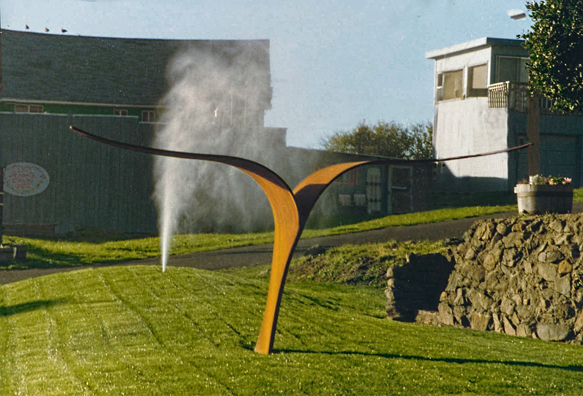
For the past twenty-four years, a spume of water has sprayed into the air every minute or so from Memorial Day to Labor Day. Kids shriek as they run through the spray. Lovers know it’s good luck to have the spout go off as they walk past. Drivers passing through Yachats turn for a second look as the spray hits their windshields. Was that…a whale??

Yes, it’s a whale! The Whale in the Park was the brainstorm of local metal sculptor Jim Adler. The rock wall of the little park suggested a fjord to his fertile imagination; a photo of a whale sounding, its powerful flukes arched against the sky, inspired a vision for a whale sculpture. At first, Adler thought installing a pump too “kitschy” to represent this dignified animal. But the spout is what we know of whales, the signal that alerts whale watchers that there is an animal of great power gliding below the surface. The pump became part of the project.

The whale caught the imagination of the entire community. A committee, including Tom Smith, Joanie Bicksler, Karen Schuster, Mary Welch, Judy Grist D’Ville, and Mary Shelley among others, sold sweatshirts with the iconic swoosh of the whale’s tail, and mailed out a whale poster to potential donors—theirs to keep whether they sent money or not. Most sent money. The Oregon Arts Commission approved a grant. The Yachats city council gave permission to install the whale in the park after Adler showed them a maquette of the sculpture, complete with a bulb to simulate the spout.  Councilman Burd Bicksler was paying careful attention when the spout went off…

The flukes were cut at Far West Steel in Eugene and shipped to Marks Brothers Rolling & Fabrication in Portland. A machine the size of a Greyhound bus bent the metal to Adler’s specifications. Then a jig was formed so the other side would come out the same. The folks at Marks Brothers were so excited by the project that they insisted on welding it themselves. Rod Smith offered to drive his truck to Portland to pick up the tail.

Back in Yachats, a group of volunteers waited at the park next to Lee Green’s logging truck and crane. Someone made a movie. Unfortunately, Smith had had a flat tire and didn’t arrive until the next day, so the film just shows everyone waiting for the whale. Finally, the massive sculpture was put in place and a cement base was poured to support it. Adler built and installed the pump. Central Lincoln PUD put in the electricity and the city supplied water. Forty yards of top soil and mushroom compost were delivered. Adler rented a truck from Rick Boston, drove to the Valley, and filled it up  with turf. Then, just when the exhausted volunteers were too tired to do one more thing, Vince Bittel showed up and laid out the turf.

Adler the Artist turned into Adler the Maintenance Man, turning the pump on in the summer and off in the fall, maintaining it and stringing rubber bands and gaskets together to keep it functioning. The city, which decided not to take ownership of the sculpture or provide maintenance, continued to provide water except in a few very dry summers.

The whale is a powerful symbol in our myths and stories. The Whale in Yachats celebrates that power, the power of creativity and imagination, and the power of a community of people working together.

Monday, June 24, 2013

Dining Al Fresco—From the Bay to Your Bucket

State Ranger Cameron Rauenhorst, known affectionately as Ranger Clameron, grins as he holds up a BIG shell. A seven-inch neck protrudes from the shell and Clameron tells us that fully extended the neck can be nearly three feet long. Known as a Gaper, Horse, Horseneck, Blue, or Empire clam, this bivalve is one of the many clams that you can harvest on Oregon beaches. Clameron dug up this particular Gaper at low tide in Alsea Bay.

“Look for the show,” he tells us. The show is the oval hole left in the sand by clams at low tide. In the case of the Gaper, it is nearly two inches in diameter. Though smaller clams are found closer to the surface, the Gaper requires a serious hole—two feet deep in some cases. “Grab a small child by the feet,” says our grinning guide, “and hold him over the hole to dig the last couple of inches by hand.”

In a net bag, Clameron displays the smaller hardshell clams he dug that morning. Butter clams, cockles, and littlenecks are also found in Alsea Bay. Someone asks where to dig. Turning toward the Alsea Bay Bridge, Clameron points to the Y-shaped cement supports, telling us that it is the largest Y-leg bridge in the country. In the arch between the third and fourth Y, he says, you’ll be able to dig your limit in about twenty minutes. (The limit is 20 clams per person per day, of which only 12 may be the big gapers or geoducks. See sidebar for daily limits for all shellfish.)

Moving over to the seawall, Clameron explains how to bait a crab trap—chicken, fish, turkey, mink, or ghost shrimp all work well—and tosses a crab ring over the edge. If you were on the docks or a boat, you would let the ring  soak for 15-20 minutes before hauling it back up. “Do it fast,” he warns, pulling the rope up hand over hand with a well-practiced motion. “If you dawdle, the crabs will crawl right out and escape.” Crab pots actually trap the crabs and can be left for up to three days.

Another option is the “crabhawk,” which you hang from the end of a fishing pole. When the crab crawls onto the screen to get the bait, there is a tug, your signal to reel in the trap, which automatically closes as soon as you start pulling it in. (Designed by Steven DeMars—visit www.crabhawk.com for more information.)

Oregon State Sport Fishing Regulations allow you to keep only male crabs—the females are laden with millions of eggs and harvesting them will jeopardize production of future crabs. Cameron demonstrates how to sex a crab: the female’s abdomen is wide, the male’s is narrow. If you need help, check it out in the pamphlet Crabbing in Oregon.

Crabs must be at least 5 ¾ inches measured in a straight line across the back immediately in front of the little bumps on the side of the crab. All females and undersized crabs must be returned to the water carefully and immediately.

Friday, June 21, 2013

The Long Tradition of the Yachats Music Festival

When Joanne Kittel and her husband Norman arrived in Yachats in 1988, the Yachats Music Festival had already been in existence for seven years. “We stumbled onto it,” says Joanne. If there had been any doubt in their minds about the wisdom of leaving Chicago and moving to this remote little village on the central Oregon coast, those doubts died when they entered the Yachats Community Presbyterian Church.

Norman had loved classical music since he was a child. On their first date, he took Joanne to a five-hour Wagner opera. Joanne learned to appreciate the music, but what really impressed her was the warmth and friendliness of the Four Seasons artists. Over the years, she and Norman formed strong ties to the performers and the board members and sponsors of Four Seasons Arts, the booking agency founded by Dr. W. Hazaiah Williams to promote music for audiences of all races and conditions and to provide venues for performances by artists of all races as well. “The opportunity to hear, to know, understand and appreciate good music,” said Dr. Williams, “will lead to far greater communication between races and people.”

And so it has, not just for the Kittels, but for many of the residents of Yachats who step up as sponsors and audience, and who volunteer, as Joanne and Norman did, to help with publicity, the artists’ reception, ushering,  and all the other tasks that support a three day music festival.

For the 20 to 30 artists who travel worldwide for their scheduled performances, the Yachats Music Festival is a treasured opportunity to play, relax, and learn together. The festival includes four workshops for the artists and festival patrons, another way to further Dr. Williams’ vision of lifelong learning through music.

Dr. Williams was the first African-American impresario to head a concert-giving organization in the United States. He believed that classical music is for everyone, and both his stage and his audience reflect the human family in all its diversity. Although Dr. Williams died in 1999, his legacy continues; the Yachats Music Festival is dedicated to his memory.

This year, the concerts take place July 12 through July 14. There is a concert each night, at 8 p.m., and an afternoon performance at 2 p.m. on Sunday. General admission to each concert is $19. Tickets are available online at www.brownpapertickets.com/event/248537 or locally at the Adobe Resort (541 547-3141) or the Yachats Visitor Center (541 547-3530 or 800 929-0477).  Member and patron packages are available at $85 and $140; call 541 961-8374 for details. Additional information is available at Four Seasons Arts, 510 845-4444, www.fsarts.org or www.yachats.info/ymf/.

Yachats Arts Guild Summer Show

The Yachats Art Guilds Summer Show opens on June 28 and runs through July 7, in rooms 7 and 8 at the Yachats Commons. The display includes oils and acrylics, wood carvings, watercolors, pen and ink, pencil, pyrography, and mixed media, as well as photographs inspired by the beauty of the “Gem of the Oregon Coast.”  All the art is for sale, as well as cards and prints.
   
The Yachats Art Guild has grown from the seven original founding members to 34 members dedicated to supporting and promoting Central Coast artists as well as the natural beauty of the area.  Works by members of the Yachats Arts Guild grace local galleries, restaurants, and hotels. The Guild maintains a permanent show at Ona Restaurant in downtown Yachats and at the Yachats Public Library. There is also a “Perpetual Art Walk” that pairs local artists with merchants in the area. Upcoming shows include the Yachats Arts Guild Fall Show, a show at the Siuslaw Library in Florence in September, and a show at Canyon Way in Newport in 2014.
The Yachats Arts Guild Summer Show, rooms 7 & 8, Yachats Commons (off Highway 101 next to the Bank) June 28-July 7 from 10 a.m. to 5 p.m. except on the last day when the show closes at 3 p.m. For more information, visit www.yachatsartsguild.com, or the Yachats Arts Guild Facebook page.

Tuesday, March 19, 2013

Keeping an Eye on the Whales

What’s as big as a big yellow school bus, weighs as much as 35 VW bugs, eats a ton of amphipods and mycid shrimp (each one no bigger than an M&M), and swims 12,000 miles a year between the Arctic feeding grounds and the good times in the Bay of Cortez?

Did you guess Gray Whale? You’re right!!

Having mated or given birth in the warm waters off the coast of Mexico, the big critters on now on their way north to the cold, food-rich waters off the coast of Alaska. People who have gone on whale expeditions to Mexico report that the whale mommies bring their calves (around 15 feet long) right up to the boats where they can be kissed and petted. You can even rub their gums, something that seems to give these big babies a lot of pleasure.

The whales don’t eat in Baja (too many other fun things to do like mating and giving birth) so the migration north is the time to get serious about putting on the pounds. They’re also not in such a big hurry (did we mention mating and giving birth after a 12-month pregnancy?) so the Oregon coast offers a great opportunity to get a look at a whale or two. They will be swimming north between 3 and 5 miles offshore, although they come in closer if there are good food sources for example near the headlands. Be on the look-out for spouts, rolling backs, and occasionally a nose (spyhops) or a tail (fluking). Although Grays are not known for breaching—that dramatic moment when ¾ of a whale comes up out of the water—they do occasionally, particularly upon arriving at their feeding grounds.

The migration north lasts from March to June along the Oregon coast, as 18,000 Very Large Animals move past, immature animals, adult males, and females without calves first, then the mothers and calves a little later. There are also resident Grays which decide, for whatever reason, to hang around. There is almost no time of the year when there isn’t a whale out there, but the concentration of the spring migration makes it more likely that you will see one—or more than one!

Trained experts are available at the official Whale Watching Spoken Here sites between 10 a.m. and 1 p.m., March 23-30, 2013. More information is available at the Oregon State Parks & Recreation whale watch website, www.whalespoken.org, or by calling The Whale Watching Center in Depoe Bay, 541 765 3304. Local visitor centers along the coast will also have information. Check out the Yachats Visitor Center, 541 547 3530 or 800 929 0477.

If you want to look for whales in a serious way, be sure to dress for weather that can range from cold, windy and wet to glorious sunshine. Layering is the way to do it, and don’t forget your sun screen. Bring binoculars and patience. Forget your cell phone and your daily obligations and get into a different rhythm. And remember: even if you don’t see a whale, you’ll be looking out at the great Pacific Ocean, a spectacular, inspiring vista in its own right.

Friday, February 1, 2013

Go Team...GoYachats!


Why would anyone come to Yachats on Super Bowl Sunday? Oh, let me count the reasons!
First, we don’t have a major league football team (yet), so you can cheer for either the Ravens or the 49ers, as loud as you want, and no one will feel bad that it wasn’t the Yachats Whales down there at the scrimmage line.

Second, perhaps you’ve had it with your home turning into a Man Cave every Sunday. You’re tired of the malls and just need a break. Sometimes this applies to the ladies only, but we aren’t making any assumptions. Everyone is welcome in Yachats! You could escape to this lovely coastal village. The weather is supposed to be really nice (as in SUNNY). You can breathe fresh air, feel that salt spray on your face, explore the many unique shops (from rocks to exotic spices, books to handmade bowls—and more more more), or just sit and read a book in peace and quiet.

But third—we can provide that man cave right here in Yachats! There are television screens at the Adobe, the Drift Inn, and in the lounge at Ona. There’s also a new place in town: Outta Gas Pizza, located in the old Boston Chevron station at the north end of town, remodeled and full of pool tables, shuffleboard, and oh yes, beer. They don’t just have a screen. They have a SCREEN. Wall to wall and floor to ceiling. Ever fantasize about being right there on the line with those 300 pound fullbacks? Here’s your chance, without fear of broken bones. The pizza’s pretty darn good too.

So what are you waiting for? Sunday is right around the corner. Make your plans now and have a Super Sunday in Yachats.

Monday, October 1, 2012

Yachats 804 Trail - Coastal Connections


Walking the historic Yachats 804 Trail connects hikers to local coastal history. The trail probably first served as a footpath for tribal people, later becoming part of County Road 804, which included the 7-mile stretch of beach between Yachats and Waldport at low tide. County Road 804 served as the settler's route of travel between the farmland of the upper Yachats River valley and Waldport's Alsea Bay until the 1930s and the completion of Highway 101. The highway replaced the oceanside portion of County Road 804, and it reverted to its ancient use as a footpath. 

During the 1970s, local citizens began a campaign to preserve the 804 as a public trail. Years of legal battles ended with a ruling by the Oregon Supreme Court to keep the public right-of-way and in the mid-eighties, the ¾ mile section from Smelt Sands State Park north to the beach became part of Oregon State Parks.

Successful mediation with local home owners in the late 1990s allowed for the completion of the 804 Trail South. The 804 Trail South is about a mile in length, stretching from the south edge of Smelt Sands Recreation Site, across the lawn behind the Adobe Resort, and through oceanside neighborhoods to the north side of the Yachats River, Yachats State Recreation Area, and downtown Yachats. 

The city’s commitment to trails for safe pedestrian use has resulted in a network of trails through Yachats. The trails connect to the Amanda Trail south of town, and up to Cape Perpetua and beyond. Volunteers and city workers, in partnership with State Parks and the US Forest Service, maintain the trails, build new trails, and develop maps and signage. 
(This article is a modification of the Yachats Chamber of Commerce history of the 804. More information is available online.)

Photo Credit: Heather Taylor

Wednesday, August 8, 2012

Cars and Bikes—Let’s All Be Safe This Summer!


It’s summer, and there are plenty of two-wheelers on the coast roads--taking the turns on 101, pumping hard up and over the coast range, or taking a leisurely ride through pretty rural valleys. Oregon welcomes cyclists and encourages cycling adventures as an integral part of the TravelOregon story, so now is a good time for everyone—motorists and cyclists—to keep a few safety thoughts in mind.

For example, sometimes it’s a pretty tight fit going around the curves south of Yachats.  While the bike lane can be up to three feet wide, there are places where it narrows next to a guard rail or just plain disappears under overgrown vegetation. Cyclists are often in the traffic lane and even where they are safely on their side of the fog line, cautious motorists tend to pull over to give the bikes plenty of room. Oregon law allows drivers to pass bicycles on the left by moving across the center line as long as the “center is unobstructed for a sufficient distance to permit the driver to pass the person operating the bicycle safely and avoid interference with oncoming traffic.” 


Most cyclists take advantage of the north winds and ride south along 101. Coming up suddenly on a line of cyclists, drivers tend to move out into the other lane—which means everyone needs to stay very alert, including the people driving north. 

On most rural roads, there is no bike lane. This means that cyclists and motorists are sharing the road. Take that phrase to heart. Sometimes there are whole families riding their bikes up the Yachats River Road. It’s a beautiful ride past grazing cows, solid red barns, alpacas and llamas, and views of the wooded hills. In fact, with the Third Annual Yachats River Valley Farm Tour coming up on August 18 (see GoYachats.com/events for details), Biking from farm to farm would be a great way to see the valley up close.


Sometimes there’s no alternative to just simply slowing down. Going around curves, drivers can come upon bikes suddenly. With the play of light and shadow on the road, bikes and their riders are often difficult to see. Assume that you won’t be able to pass safely and drive cautiously. It really won’t hurt to slow down. After all, that’s the whole point of being on vacation, isn’t it? And if you’re a local trying to take care of all the ordinary chores, slow down anyway—just remind yourself that you are lucky enough to live in a place that people come to on their vacation!

Wednesday, July 4, 2012


Love LaDeDa (and Yachats!)? Say thanks to Janet Moore Burley. Eighteen years ago she was head of the Yachats Chamber. Inspired by Pasadena's DoDah parade, she applied to the city council for a permit and wrote the rules: no motorized vehicles and no green socks. Or maybe it was purple socks. Whatever.

The idea was simple—get people to town before the fireworks. The first parade was so short, it went around twice. But it caught on, and soon crowds lined the parade route, floating red, white, and blue balloons, decked out in as much R,W, & B as they could fine. That’s the spectators we’re talking about—as good a show as the people in the parade.

The exception to the motorized vehicle prohibition is the municipal manure spreader, which carries the mayor and members of city council. Now what might that message be????
Paraders come in singles and groups, families and associations. The city’s hyperactive trails committee and adjunct weed-pullers (YIPS) deck themselves out in ivy and other invasives. There’s always a science team with strange images of deep sea critters. Look for people on bikes and people on skate boards, and dogs dogs dogs. The ever-popular Umbrella Drill Team, which has been opening and closing umbrellas in something like synchronicity almost as long as the parade has existed, will march by in semi-unison.

I’ve been in Yachats almost as long as the parade and I know it is not an event to miss. Get out there and laugh, gawk, gasp in amazement, clap and let the crazies know how much we all appreciate them. Then wander around Yachats and ENJOY!! I know I will.

Monday, September 12, 2011

The Impact of Climate Change on the Oregon Coast

The damage done recently by hurricanes along the east coast provides dramatic evidence of the impacts of climate change on vulnerable coastal communities. So far, the west coast has appeared to be exempt from such natural disasters, but this reprieve is unlikely to last forever. Higher ocean levels, erosion of coastlines, and more violent storms will cause damage to land and buildings along the coast. How will we prepare for what the future is sure to bring? One way is to be informed and understand the forces at work.

For the past forty years, Oregon Shores/Coast Watch has worked to keep our beaches accessible to the public, to keep them clean, and to increase our understanding of the coastal environment. Not surprisingly, Oregon Shores has taken on the challenge of climate change as well.

This is the topic of the Oregon Shores 28th annual conference, to be held this year on Saturday, September 17, in Newport. The lineup of speakers represents a depth of knowledge which we all need to understand and prepare for what climate change is likely to do to our coastal communities.

Al Solomon, a recently retired global change ecologist who was head of the U.S. Forest Service’s climate research team in Washington DC, will speak on “Climate Change and Its Impacts on Coastal Oregon.”    

Steve Adams, managing director of the Climate Leadership Initiative, associated with Willamette University, will discuss “Preparing for Climate Change on the Oregon Coast: Insights for Local Climate Adaptation From Initiatives Around the Country.”

Also speaking will be Oregon State University historian William Robbins. His talk, “Industrializing Oregon’s Coastal Watersheds: The Consequences of Hubris” will explore ways in which human activity has changed the coastal landscape over the past two centuries.

Finally, geologist George Priest of the Oregon Department of Geology and Mineral Industries will address the question “The March 2011 Tsunami: Could It Happen Here?”

There are other activities planned, including a luncheon, a dinner cruise of Yaquina Bay, and a bonfire in Nye Beach. For more information about the conference or to register offline, contact Pat Wolter, 503 647-2012, or email: pcwolter@comcast.net. For online registration, visit www.oregonshores.org.

Monday, May 30, 2011

Remembering History, Healing the Past

From left to right, Ron Brean, Mayor of Yachats, Robert Keeler, Chair of the Oregon Historical Marker Committee, and Warren Brainard, Chief CTCLUS
On Friday, May 27, the new historical marker was dedicated at Yachats State Park. The sign, sponsored by the City of Yachats and the Oregon Travel Information Council, is the newest member of the regional marker series, and the first on the coast.

Our new sign tells the story of the land and the people who have lived here. The land was formed fifty thousand years ago, as tectonic plates collided with the continental land mass. People arrived at least five thousand years ago, migrating over the Arctic land bridge from Asia and slowly making their way down the coast. About three hundred years ago, new people arrived from Europe and other parts of America. Every movement, both geological and cultural, changed the landscape, but once the Euro-Americans arrived, change began happening at an accelerated pace.

The marker celebrates the industry of the early pioneers whose can-do energy created an economy based on timber and fishing. Small farms were carved out of the wilderness and gradually transportation shifted as highways were constructed along the rugged coastline. But the marker also pays homage to the history of the Native peoples who were displaced and in many cases destroyed by the activities of the newcomers. The Alsi people, already decimated by disease, and the Coos and Lower Umpqua who were forcibly marched to Yachats, were confined to the Alsea Sub-agency, a part of the larger Coast Reservation (1859-1875), Many perished due to the neglect, abuse, and broken promises of the federal government. The surviving Coos and Lower Umpqua, many of whom are now part of the Confederated Tribes of the Coos, Lower Umpqua, and Siuslaw Indians (CTCLUSI), and what remained of the Alsi (now part of the Confederated Tribes of Siletz) had such feelings of horror about Yachats that they avoided the area entirely.

However, a healing has taken place, thanks to many members of the Yachats community and the willingness of the Tribes to open their hearts to the offer of reconciliation. The dedication ceremony was attended by Chief Warren Brainard of the CTCLUSI, who remembered those who died and also looked forward to the new connections being forged between the two communities. Tribal Elder Doc Slyter saluted the Ancestors with his flute music. And Yachats Mayor Ron Brean spoke movingly about the pace of change and the need for healing and care so that we become mindful of the results of our actions and avoid damage to our beautiful environment and all the people who live here and call it home.

GoYachats salutes all the People of the Oregon Coast!

Monday, May 23, 2011

Remembering the ladies....

When you head over to the Yachats Ladies Club on Saturday (visit GoYachats.com for hours and location) for the pie social, take a minute to appreciate the ladies and what they have accomplished.

The Yachats Ladies Club started in 1927 with fourteen members and a purpose: to promote the welfare of the community. They met in members’ homes, charged 10 cents at each business meeting for dues, and raised additional funds by making and selling quilts and aprons, holding banquets and dances, and organizing a Christmas bazaar.

When the state of Oregon announced they were going to demolish the Yachats Dance Hall to make way for a park at the point, the members of the club decided to buy the building for a clubhouse. That was in March, 1928; by the end of the year, the Ladies Club had $100.32 in their treasury.

The amount of money they needed was daunting. The state agreed to sell the dance hall for $100, but they needed a place to put it. Sir Robert Perks, an Englishman who owned much of the available land in Yachats at that time, agreed to donate the lot on Third Street, and the stumps were removed with 20 pounds of blasting powder. The dance hall was moved at a cost of $500, and they bought a piano for $100. Money was borrowed and paid back over time. There were expenses for insurance, licenses, and other fees. Over the following months, the ladies continued to hold fundraising events, collect dishes and silverware to equip the kitchen, and do all the work to finish the hall and make it useable.

For many years, the Ladies Club was the only place in town available for meetings. Church services were held there as well as card games. A lending library was established in 1930. And of course, the dances: every Saturday night, various musicians rented the hall. The club members ran the ticket booth, the checkroom, and the food and soda pop concessions. The musicians provided their own floor wax. Things got rowdy on a Saturday night in those days. The musicians were supposed to keep the good times under control, but some damage occurred.


The pie social started on the Fourth of July, 2002. They had to move that event to the Commons because of demand, but the pie socials on Memorial Day and Labor Day weekends still take place at the newly refurbished Ladies Club on Third Street. “It’s a thing,” says club president Sandy Dunn. Indeed it is, with just about every variety of pie you can imagine. Be sure to get yours this weekend!

Sunday, May 15, 2011

“The nicest people in the universe….”

Valeria drove north along the coast from San Francisco. It was late spring, 1985, and the California hills had already turned the tawny color of a lion’s back. Until she reached Oregon, where suddenly everything was green. The further north she went, the greener it became. “It was like nowhere I had ever been before,” she said.

Back home in Indianapolis, she subscribed to Oregon Coast magazine and found real estate bargains she couldn’t believe. There was a house, right on the beach and—“almost free!” So she loaded everything into her car and headed for Florence (which, being the place where the magazine was published, seemed to be the center of the universe.)

Surprise, surprise—the house on the beach was a wreck and Florence, it turned out, was not the center of the universe. But there she was, ready for something brand new, so she began a methodical search of the coast, driving from Brookings to Astoria, Astoria to Brookings.

“I narrowed it down to Bandon, Yachats, and Neskowin,” she says. But in Bandon, all the realtors were on vacation. In Neskowin, there were no realtors at all. And in Yachats, the owners of the house she wanted to look at were in Mexico and couldn’t be reached.  But there was another house, halfway between Waldport and Yachats…

Not long after that, she started a little gift shop and called it ToadHall. She’s never looked back, not even when the snows of ’89 blanketed the beach and drifted against the Little Log Church and she thought just maybe she should have packed her cross-country skis in the car.

It wasn’t about the weather, she realized. It wasn’t even about the gorgeous setting of green trees and sparkling ocean. It was about people and community. In Yachats, you could get a book from the library without producing ten pieces of ID. At the grocery store, the person with five items, standing in line in front of you, lets you, with just two items, go first.

One evening, Valeria left ToadHall at the end of the day, forgetting to lock the doors. The lights were on, and the music too. Eventually, a neighbor came in, turned out the lights and shut off the music, then drove to her house to make sure she hadn’t been abducted by aliens. When she came the next morning, she looked around. People had come in, thinking the store was open. On the counter she found handwritten receipts and money for items people had bought.

“The people in Yachats,” says Valeria, “are the nicest people in the universe.”

Exploring Our Backyard….The Yachats Community Park

On a sunny May morning, my dog and I explored the Yachats Wetlands Community Park. Red-winged Blackbirds trilled from the willows and cattails where they make their nests. Wilson’s Warblers flittered over the reeds like gold coins tossed in the air. American Goldfinches, sometimes called the wild canary, surrounded the feeder at the end of the boardwalk, where we turned and walked through a shady forest of shore pines. The thick duff muffled our footsteps before we wandered back on another path to see Black-headed grosbeaks, a beautiful orange bird with black and white stripes on its wings.

A Great Blue Heron has also come to live in the wetlands. Although these shy birds usually take off in an improbable squawking flight when someone intrudes on their space, this one has gotten used to visitors. Of course, the ready supply of frogs, its favorite diet item, is a big incentive to stay calm.

Suddenly there was a dramatic air battle going on above my head. Two crows were pursuing a Merlin falcon, sometimes called a pigeon hawk. Similar to the Peregrine falcon, this raptor preys on other birds. The crows swooped and attacked and finally chased the falcon off.

I sat on a bench and waited for the high-pitched frog chorus to start up again. Spring peepers--also called green chorus frogs. What a perfect name for these bright light singers of the season! I didn’t hear the slightly deeper tone of the endangered Red-leg frog, but the restored wetland has provided habitat for them too.

This healthy wetland area is the result of years of dedicated work by a committee of Yachats folks, including horticulturists, botanists, fish biologists, hydrologists, and many others willing to do the hard work of recovering a natural habitat that had been lost over the years to a snarl of blackberries, trash and dirt. The City of Yachats was a generous partner. For awhile, it felt as if the mess had been exchanged for a wasteland, as front-end loaders cleared out the blackberries and trash, but gradually, the area has recovered. It is the natural catchment area for the water that runs off the hills on the east side of town, and the shallow ponds began to fill up. The boardwalk was built and volunteers brought in and planted native vegetation.

The Wetlands Community Park is located behind the Commons and maps are available online at GoYachats.com or at the Yachats Visitor Center. It can be part of a longer hike on Yachats’ extensive trails, a pass-through on your way to a latte, a bird-watching expedition, or just basking in the morning sun.

Monday, May 2, 2011

Blissed Out Bookies

For the past five or six years, a group of women from Sisters has rented a house in Yachats for their annual book discussion. This year, the date happened to coincide with Easter weekend and some really lovely sunshine.

The house is right on the beach, just past Tillicum campground. Tote bags filled with food and books lined the hallway and at least half the women were in the open kitchen at any given time preparing fabulous meals. I was a guest for lunch—lentil soup with a bit of curry, salmon salad, fresh greens, good bread, and homemade apple strudel for dessert, warm from the oven. They had just returned from The Annual Shopping Excursion into town where they bought books at Mari’s, scarves at Patty-Kait, and this-and-that from ToadHall and other unique Yachats shops.

The sunlight streamed in from two story high windows and sparkled on white waves rippling up the beach. A bit of a breeze stirred the beach grass and a little gray cat crept along the sandy paths. There were plans for dinner (lasagna was mentioned) and a late night around the table discussing Red by Terry Tempest-Williams and playing Mexican Train dominos, not for the faint of heart.

Yachats is the perfect place for book lovers and book discussion groups. The week before, the Friends of the Yachats Library held a fantastic book sale which drew bookie folks from near and far. I often see six or seven people seated around a table at the Green Salmon talking books over cups of lattes and tea. In fact, Yachats wants YOU to come here with your book group! Contact: andrea@goyachats.com for more information about our Book Lovers promotion.

Monday, April 25, 2011

A Tourist in My Own Hometown

At last year’s Rubber Ducky Race, part of the Fourth of July celebration in Yachats (LaDeDa!!), I won a night at Ambrosia Gardens B&B. Finally, in mid-April, I was going to claim my prize and spend a night at the cozy inn, located about six miles south of Yachats.

I arrived to find proprietor Mary Coello on her knees pulling weeds out of the immaculate lawn. This appears to be what she does when she isn’t greeting guests and making breakfast, and the gardens demonstrate that loving, constant care. My room was on the second floor, off the common room, with handmade quilts on the bed, a private bath, and a view to the west.

It’s not easy to be a tourist in your own hometown. I almost forgot that travelers who stay at bed & breakfast inns need to plan for dinner on their own, which is part of the travel adventure, of course. I called some friends and arranged to meet them at Ona, Yachats’ newest restaurant. I chose a light supper—tomato bisque with grilled cheese sandwich. It sounds pretty down home, but the smoky grilled bread from local Bread & Roses Bakery elevated a childhood favorite to something more sophisticated.

    When I returned to Ambrosia (Mary once again pulling weeds in the gathering dusk), the sun was just slipping over the edge and the sky was filled with warm orange light. This was significant: it wasn’t raining! It’s been a wet month and it was pure joy to be able to see the sunset, with black shore pines silhouetted against the sky.

    Morning, and the air was fresh, clear, brisk. I bundled up and headed down to the beach, where an outgoing tide revealed contorted shapes of ancient lava flows. Seabirds fluttered, swooped, cried their shrill cries, and scattered before small waves. The sun peaked the forested ridges to the east and filled the white foam with light.

    Back at Ambrosia, there was hot coffee and pleasant conversation with the other guests, a couple from Crescent City who had spent the previous day exploring Yachats, including the historic Little Log Church, before having dinner at the Drift Inn. We tucked into Mary’s scones, frittata and fruit cup until it was time to pack up and head home.

    Not a bad way to start my hometown adventures!

Sunday, April 17, 2011

Ready. Set. GoYachats!

Stories are what we are all about, whether we are travelers or residents, tourists or the folks who provide the services to make your visit a fabulous experience (so you will go home with great stories to tell!)

Yachatians have plenty of stories. There are stories that we have inherited from the First People who lived along the coast for thousands of years. There are people who trace their roots back to pioneer times and people who drove through last week and came back to buy a house. Yachatians are the folks who sell books and rocks, coffee and art. They pump gas, rent videos, own motels, cash checks, pour wine, scoop ice cream, and take your order for dinner. They’ll tell you where to go for a beach run, buy fresh seafood, rent a cozy cottage, luxuriate in a spa overlooking the ocean, get a massage, see rare rhododendrons, walk in the woods, play Frisbee with your dog, find chanterelles. (Okay, they probably won’t tell you where to find chanterelles—but you can buy them at our local market.)

We’re friendly folks, by and large. Order a cuppa at the Green Salmon Coffee Shoppe or the Village Bean Coffee Cafe and strike up a conversation. And visit the Yachats Beach Blog often to hear our stories.